Fiberglass is one of those materials that quietly does an enormous amount of work in the industrial world. It helps move chemicals, store corrosive liquids, strengthen structures, reduce weight, and extend service life in environments that can be brutal on traditional materials. But while people often talk about “fiberglass” as if it is one thing, the truth is that the way fiberglass is manufactured can dramatically affect how it performs.
Three of the most common composite manufacturing methods are hand lay-up, filament winding, and pultrusion. Each has its own strengths, limitations, and ideal applications. None of them is universally “best.” The right choice depends on what you are building, the environment it will face, the shape required, the production volume, and the performance priorities of the finished part.
That said, hand laid fiberglass continues to hold an important place in industry for good reason. In the right application, it offers flexibility, repairability, customization, and corrosion-resistant design advantages that can be difficult to match with more automated methods.
First, What Changes Between These Methods?
At a basic level, all three methods combine glass reinforcement with a resin system to create a composite material. But the arrangement of the fibers, the amount of control over the layup, and the type of shapes that can be produced vary quite a bit.
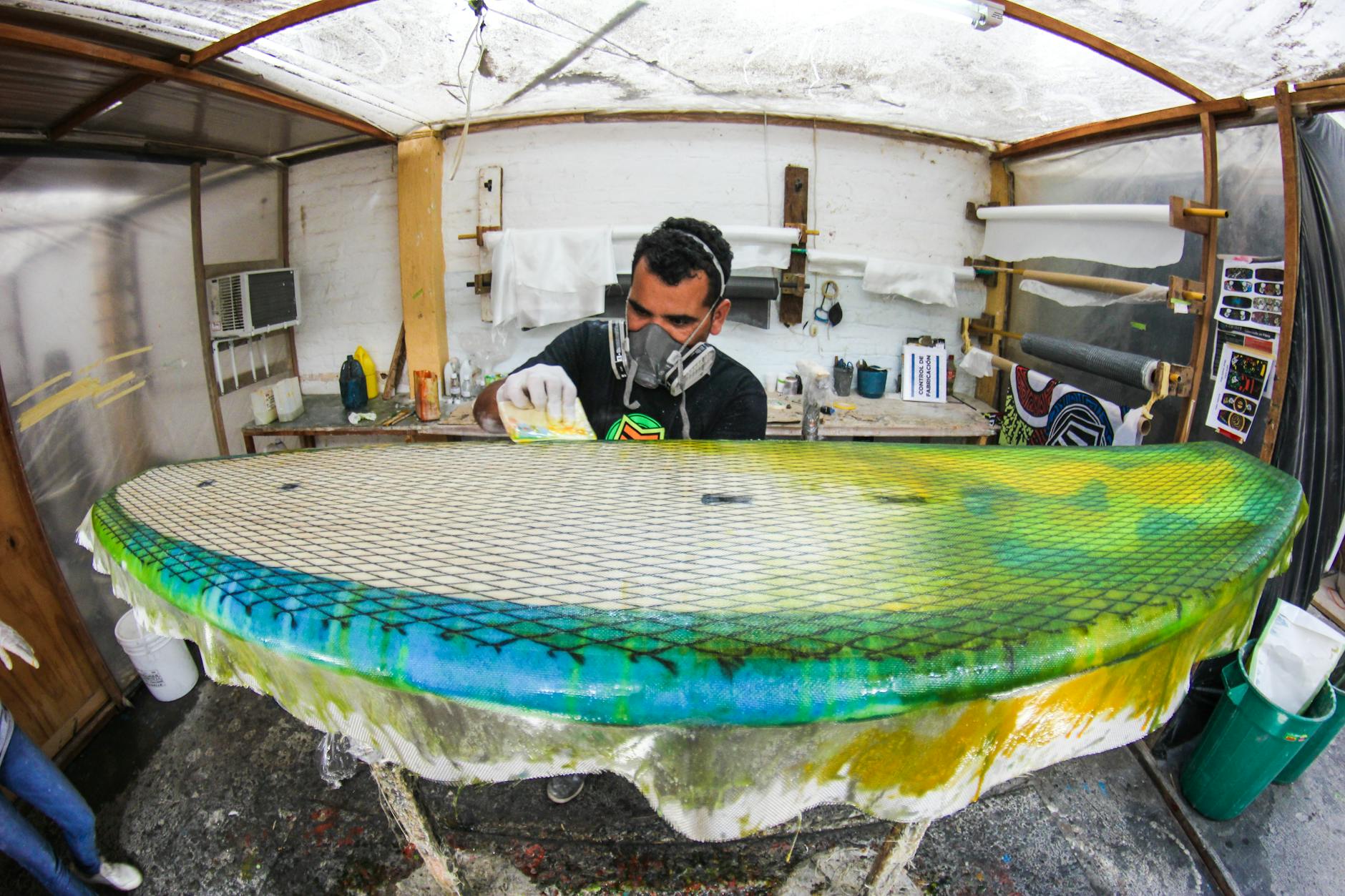
Hand lay-up involves placing layers of fiberglass reinforcement by hand into or onto a mold, then saturating those layers with resin and consolidating them into the final shape.
Filament winding uses continuous resin-wetted fibers wound under controlled tension around a rotating mandrel, usually to create cylindrical or round parts.
Pultrusion pulls continuous fibers through a resin bath and then through a heated die to make long, constant-profile shapes such as beams, channels, rods, and structural members.
All three methods can produce strong, useful composite parts. The difference is in how that strength is distributed, how much shape freedom exists, and how well the process fits the real-world demands of the product.
Why Hand Laid Fiberglass Still Matters
Hand lay-up is one of the oldest and most widely recognized fiberglass fabrication methods, but age should not be mistaken for obsolescence. It remains highly relevant because it solves problems that automated methods are not always designed to solve.
One of its biggest advantages is geometric flexibility. Industrial systems are rarely made of simple, constant shapes. They often involve elbows, transitions, flanges, nozzles, custom tanks, hoods, ductwork, repair areas, and field-modified equipment. Hand lay-up allows fabricators to build around these realities rather than forcing the design into the limits of a machine process.
It also allows for a high degree of material tailoring. Different reinforcement types can be layered in specific sequences. Resin-rich corrosion barriers can be built into the laminate. Extra reinforcement can be placed where stress is expected. Thickness can be adjusted in local areas without retooling an entire production process. This is particularly useful in chemical processing and other corrosive industrial settings where not every square inch of a component faces the same mechanical or chemical demands.
Another practical benefit is repairability. Hand-laid fiberglass is often easier to repair, modify, reinforce, or rebuild in the field than parts made through more rigid manufacturing routes. In many industrial environments, that matters just as much as initial production efficiency.
The Chemical Resistance Conversation
When people discuss corrosion performance, it is important to be precise. Fiberglass does not get its chemical resistance from the manufacturing method alone. It comes primarily from the resin system, the corrosion barrier design, the quality of fabrication, and the service environment.
So it would not be accurate to say that hand lay-up is automatically more chemically resistant than filament winding or pultrusion.
However, it is fair to say that hand lay-up can offer important advantages in how a corrosion-resistant laminate is built, especially in custom industrial equipment. A hand lay-up process can allow for a carefully constructed corrosion liner or surfacing veil layer, followed by structural reinforcement behind it. That makes it well suited for tanks, ducts, scrubber components, piping accessories, and custom process equipment where corrosion resistance is a major design concern.
In other words, hand lay-up does not magically make a part more chemical-resistant. But it can make it easier to design and fabricate a laminate specifically for corrosive service, particularly when the part geometry is custom or the service conditions are demanding.
Where Filament Winding Excels
Filament winding shines when the part is round, repeated, and performance-driven. Pipes, pressure vessels, and storage tanks are classic examples.
Because the fibers are laid down under controlled tension and can be oriented very precisely, filament wound parts can achieve excellent structural efficiency. This is especially valuable in applications where hoop strength or pressure performance is critical. For cylindrical products that need consistency across repeated production runs, filament winding is often an outstanding option.
It also tends to be more repeatable than purely manual fabrication. That consistency can be attractive for standardized systems where dimensions, wall construction, and mechanical properties need to be tightly controlled across many units.
The tradeoff is that filament winding is naturally more limited in the shapes it can create. It is exceptionally good at what it does, but what it does best is not everything. Once the geometry becomes highly irregular, heavily customized, or dependent on hand-fitted features, the process becomes less natural and less economical.
Where Pultrusion Fits Best
Pultrusion is ideal for producing long, straight parts with a constant cross-section. Think ladder rails, grating components, channels, angles, beams, and other structural profiles.
Its biggest strengths are speed, repeatability, and efficiency in volume production. Once the tooling is set, pultrusion can produce a large number of identical parts with excellent dimensional consistency. For structural applications, that can be a huge advantage.
Pultruded shapes are used widely in environments where corrosion resistance, low maintenance, electrical insulation, or weight savings are important. In chemical plants, wastewater facilities, cooling towers, and coastal environments, pultruded fiberglass structural members often make a lot of sense.
But pultrusion is also the most shape-limited of the three methods discussed here. If the part does not have a constant cross-section from one end to the other, pultrusion is usually not the answer.
Custom Work vs. Standardized Production
One of the clearest ways to compare these methods is to ask a simple question:
Are you building the same thing over and over, or are you solving a specific problem?
If you are manufacturing standardized pipe, vessels, or structural members in higher volumes, automated methods like filament winding and pultrusion may offer major advantages in efficiency and repeatability.
If you are creating specialized equipment, unusual geometries, one-off components, field repairs, process-specific ducting, custom fittings, or chemically resistant laminate systems tailored to a particular service, hand lay-up often becomes much more attractive.
This is why hand laid fiberglass remains common in industrial fabrication shops. Industry is full of real-world conditions that do not fit neatly into a standard profile or a perfect cylinder.
The Human Factor: Skill Still Matters
One reason hand lay-up can have mixed reputations is that its quality depends heavily on execution. A well-made hand-laid laminate can perform extremely well. A poorly made one can suffer from inconsistency, excess resin, voids, dry spots, poor consolidation, or uneven thickness.
That is not really a flaw in the method itself as much as a reminder that manual fabrication depends on craftsmanship, process control, and experience.
Filament winding and pultrusion reduce some of that variability through automation, which is one reason they are so valuable in the right settings. But automation is not a substitute for fit-for-purpose design. A beautifully repeatable part is only useful if it is the right part for the job.
Cost Is More Complicated Than It Looks
At first glance, automated methods can seem like the obvious choice because they often improve throughput and consistency. And in high-volume, repeatable production, they often are the more economical route.
But total cost is not just about cycle time.
Tooling expense, setup complexity, product geometry, required customization, transportation constraints, and future repairs all matter. For lower-volume custom work, hand lay-up can be more cost-effective because it avoids expensive tooling and allows direct adaptation to the project’s specific needs.
That is why comparing these methods purely on “cheap vs. expensive” usually misses the bigger picture. The more useful question is: Which method delivers the right performance at the right total lifecycle value?
A Balanced Way to Think About It
Instead of treating these methods like competitors in a winner-take-all contest, it is more accurate to think of them as specialized tools.
Hand lay-up is often the better choice when customization, complex geometry, field adaptability, corrosion barrier design, or repairability matter most.
Filament winding is often the better choice when round parts, pressure performance, fiber orientation control, and repeatable cylindrical production are top priorities.
Pultrusion is often the better choice when long, straight, structural profiles need to be produced efficiently and consistently.
That balance matters because the best industrial solutions rarely come from forcing one process into every application. They come from understanding the job, the environment, and the tradeoffs.
Why Hand Lay-Up Continues to Earn Its Place
Even in an era of advanced automation, hand laid fiberglass remains deeply relevant because industry still needs custom problem-solving. Plants still need odd fittings, retrofits, repair work, chemical-resistant laminates, transitions, and custom-built equipment that does not fit a standard profile.
Hand lay-up offers a level of versatility that is hard to dismiss. It allows fabricators to respond to real conditions instead of idealized ones. When done correctly, it can produce durable, corrosion-resistant, service-ready parts tailored to demanding industrial environments.
That does not make it the answer for every product. But it does make it far more than an old-school method hanging on by tradition.
It remains a practical, capable, and in many cases strategically valuable manufacturing process.
Final Thoughts
Fiberglass manufacturing is not one-size-fits-all. Hand lay-up, filament winding, and pultrusion each bring real advantages to the table, and each earns its place in modern industry.
For standardized cylindrical parts, filament winding can be a smart and efficient choice. For consistent structural profiles, pultrusion is hard to beat. But for custom geometries, corrosion-focused laminate construction, repairable systems, and project-specific industrial fabrication, hand laid fiberglass continues to prove why it is still widely used.
In the end, the smartest choice is not the method with the biggest machine or the most automation. It is the one that fits the application best.